Mount Bromo Travel Guide
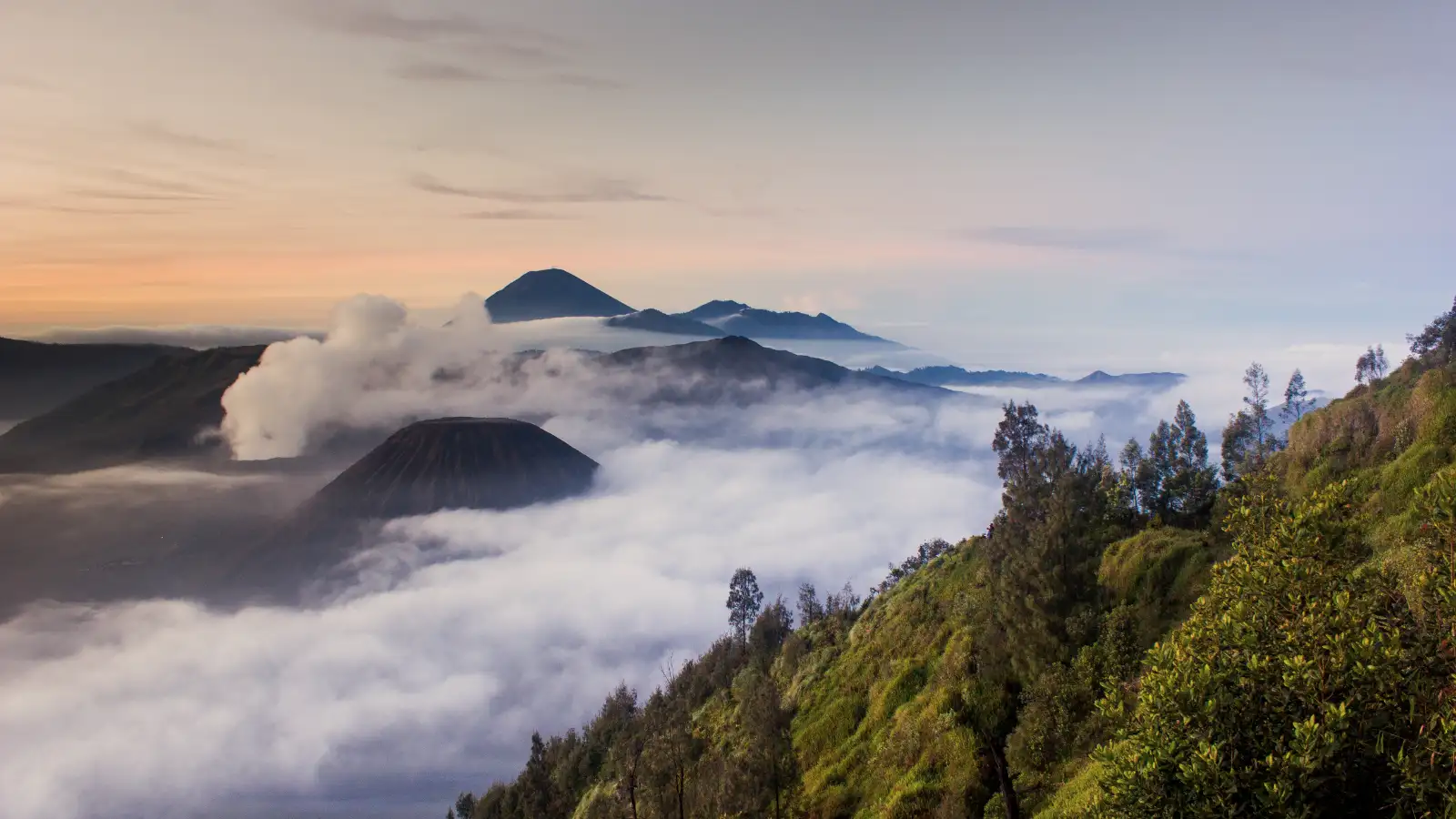
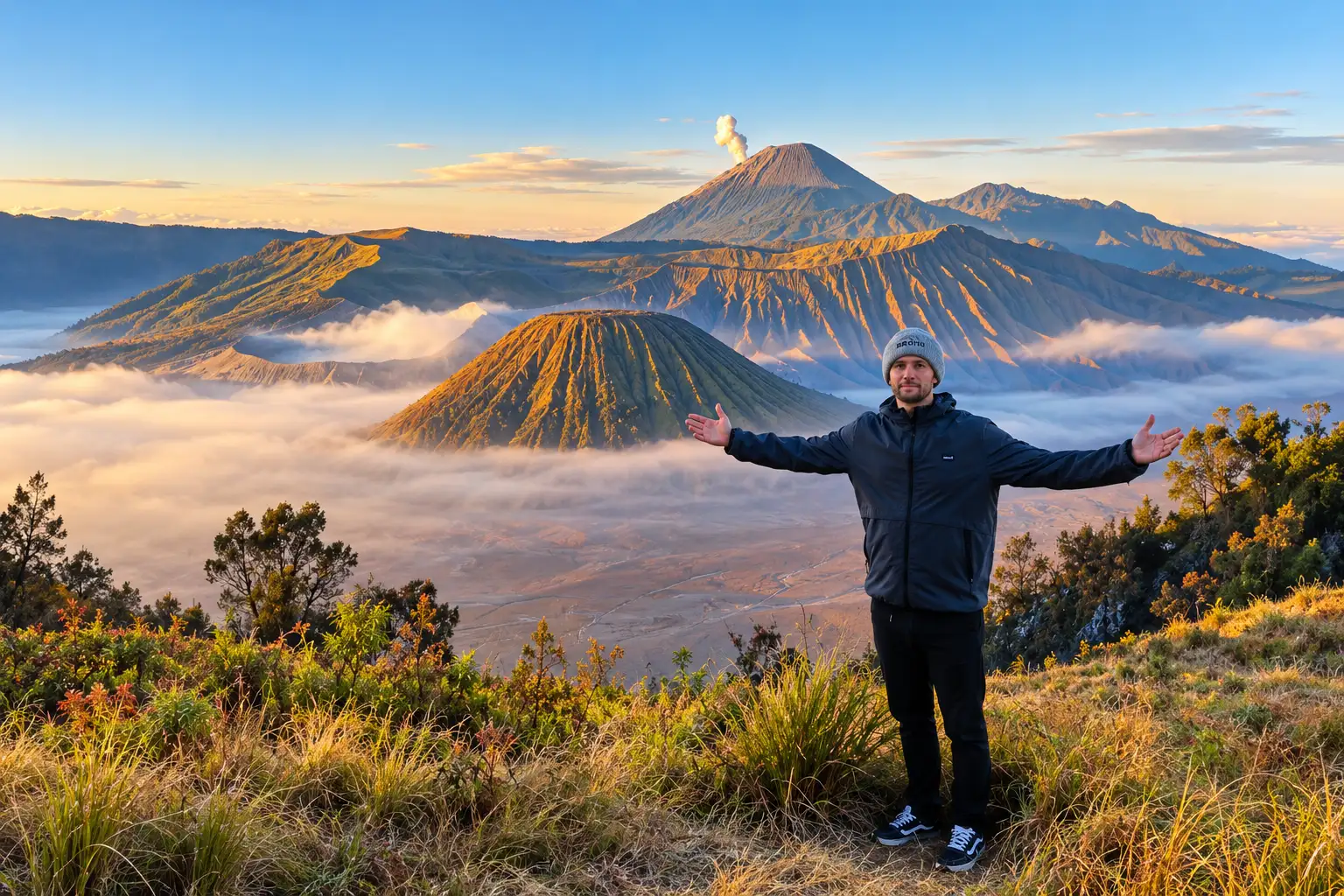
Before sunrise, the mountains of East Java exist almost entirely in darkness. The air is cold, the roads are quiet, and somewhere beyond the surrounding hills lies an enormous volcanic landscape waiting for the first light of morning. As the horizon gradually brightens, the silhouettes of Mount Bromo, Mount Batok, and the distant Mount Semeru begin to emerge above a vast expanse of volcanic sand. Clouds sometimes gather beneath the viewpoints, transforming the caldera into an extraordinary landscape that appears to float above the morning mist.
This is the moment that has made Mount Bromo one of Indonesia’s most recognizable travel destinations. Yet the experience of visiting Bromo extends far beyond a sunrise photograph. The journey leads into an ancient volcanic caldera, across a remarkable Sea of Sand, toward an active crater, and into a cultural landscape shaped by the traditions of the Tenggerese people. Every part of the region tells a different story about the relationship between mountains, nature, and human life.
For travelers exploring Indonesia, Mount Bromo offers an exceptional introduction to the volcanic landscapes of East Java. Its dramatic scenery, relatively accessible trekking experience, and opportunities for cultural discovery make it an appealing destination for first-time visitors and experienced travelers alike. This comprehensive Mount Bromo Travel Guide explains what makes the region special, how to plan your journey, which places deserve your attention, and how to experience the landscape beyond its famous sunrise.
Understanding Mount Bromo and the Tengger Caldera
Mount Bromo is located in East Java, Indonesia, within Bromo Tengger Semeru National Park. The volcano rises from the floor of the Tengger Caldera, a large volcanic depression surrounded by steep mountain walls and a broad sandy plain. Rather than standing alone as an isolated mountain, Bromo forms part of a dramatic collection of volcanic features that create an extraordinary panorama across the national park.
At approximately 2,329 metres above sea level, Mount Bromo is not among Indonesia’s highest mountains. Its appeal, however, comes from its setting rather than its elevation. The relatively modest volcanic cone stands within an enormous caldera, surrounded by the contrasting forms of Mount Batok, Mount Kursi, Mount Watangan, Mount Widodaren, and the distant Mount Semeru. The resulting landscape combines steep ridges, open volcanic terrain, and a horizon dominated by mountain silhouettes.
The wider national park extends across a much larger region, encompassing highland landscapes, volcanic formations, forests, and areas of significant ecological and cultural importance. Mount Bromo is therefore only one part of a broader destination that rewards travelers who have time to explore beyond the most familiar viewpoints.
One of the most fascinating characteristics of Bromo is the contrast between its geological scale and its accessibility. Visitors can experience an active volcanic environment, observe the caldera from elevated viewpoints, cross the sandy plain, and approach the crater within designated access areas, all within a relatively compact itinerary. This combination explains why Bromo has become such an important destination for international tourism in Indonesia.
Why Mount Bromo Is Worth Visiting
Some destinations impress through a single landmark, while others become memorable because of the atmosphere surrounding them. Mount Bromo belongs to the second category. Its landscape changes dramatically throughout the morning, and the experience of seeing the volcano from different perspectives creates a sense of discovery that cannot be captured in one photograph.
At sunrise, the caldera appears almost theatrical, with mountain silhouettes emerging from darkness and clouds sometimes filling the lower landscape. Later, when the sunlight reaches the Sea of Sand, the scenery becomes more defined. The dark volcanic terrain, rugged peaks, and scattered vegetation reveal a different character, while the approach toward the crater introduces visitors to the physical landscape of an active volcano.
Beyond its natural scenery, Bromo offers an opportunity to understand the cultural identity of the Tengger region. Traditional villages, religious practices, and the annual Yadnya Kasada ceremony demonstrate that the mountains are not simply a tourism destination. They are also part of a living cultural landscape with deep significance for local communities.
For travelers interested in photography, geography, culture, or outdoor experiences, Mount Bromo offers several dimensions of exploration. It is equally suitable for a short mountain excursion and as the starting point for a longer journey through East Java.
Mount Bromo Sunrise: Experiencing the Caldera at First Light
The Mount Bromo sunrise is the experience most travelers associate with the destination. It begins long before the sun appears, with an early departure toward one of the viewpoints overlooking the Tengger Caldera. Depending on the starting location and selected viewpoint, visitors may travel by jeep, walk along designated paths, or combine transportation with a short hike.
At the viewpoint, the landscape gradually reveals itself as the sky changes color. Mount Bromo becomes visible within the caldera, Mount Batok rises beside it, and Mount Semeru may appear in the distance when atmospheric conditions allow. The first sunlight touches the surrounding mountain ridges, creating a contrast between illuminated peaks and the darker terrain below.
The most remarkable mornings are sometimes accompanied by a sea of clouds, which gathers across the lower valleys and creates the impression that the volcanic landscape is surrounded by an ocean. However, this phenomenon depends entirely on weather and atmospheric conditions. Clear skies, mist, cloud cover, and haze can all influence the view, and no sunrise panorama can be guaranteed.
Mount Penanjakan
Mount Penanjakan is among the most famous viewpoints for observing the Bromo sunrise. Positioned above the caldera, it provides a broad perspective across the volcanic landscape and is particularly popular with photographers seeking the classic composition of Mount Bromo in the foreground and Mount Semeru on the distant horizon.
Because Penanjakan attracts many visitors, arriving early is important, especially during weekends, holidays, and peak travel periods. The final approach may involve a short walk from the vehicle parking area, and the cold morning air can make waiting at the viewpoint uncomfortable without suitable clothing.
Seruni Point, King Kong Hill, and Bukit Cinta
Several other viewpoints offer different perspectives of the Tengger Caldera. Seruni Point provides an elevated view from the Probolinggo side, while King Kong Hill and Bukit Cinta are located along the mountain slopes associated with the Penanjakan route. Each location has its own relationship to the surrounding peaks, terrain, and sunrise direction.
Choosing a viewpoint should depend on your route, available time, weather, and personal preferences rather than simply following the most popular location. A local guide or experienced driver can help travelers understand the available options and make practical decisions based on current conditions.
The Sea of Sand: Walking Across a Volcanic Landscape
After sunrise, the journey continues into the Sea of Sand, known locally as Lautan Pasir. This vast volcanic plain occupies the floor of the Tengger Caldera and forms one of the most distinctive landscapes in Indonesia. Its dark sandy surface contrasts with the surrounding mountain walls, while Mount Bromo and Mount Batok rise dramatically from the open terrain.
Crossing the Sea of Sand provides an entirely different experience from watching the sunrise above the caldera. From the ground, the surrounding mountains appear much larger, and the scale of the landscape becomes easier to appreciate. The terrain is exposed, with little shade, and the combination of wind, volcanic dust, and changing light gives the area a distinctive atmosphere.
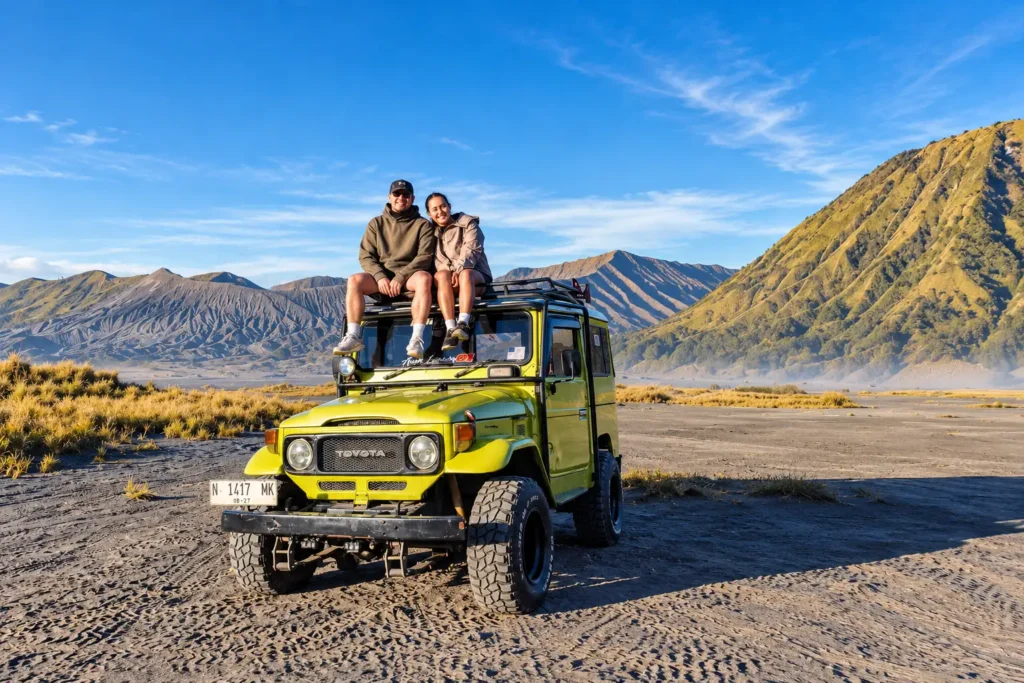
Many visitors explore the sandy plain using a local four-wheel-drive jeep. The vehicle allows travelers to cross the volcanic terrain and reach designated areas near the crater, while also making the journey practical for those with limited time. Depending on access conditions, travelers may also explore parts of the plain on foot.
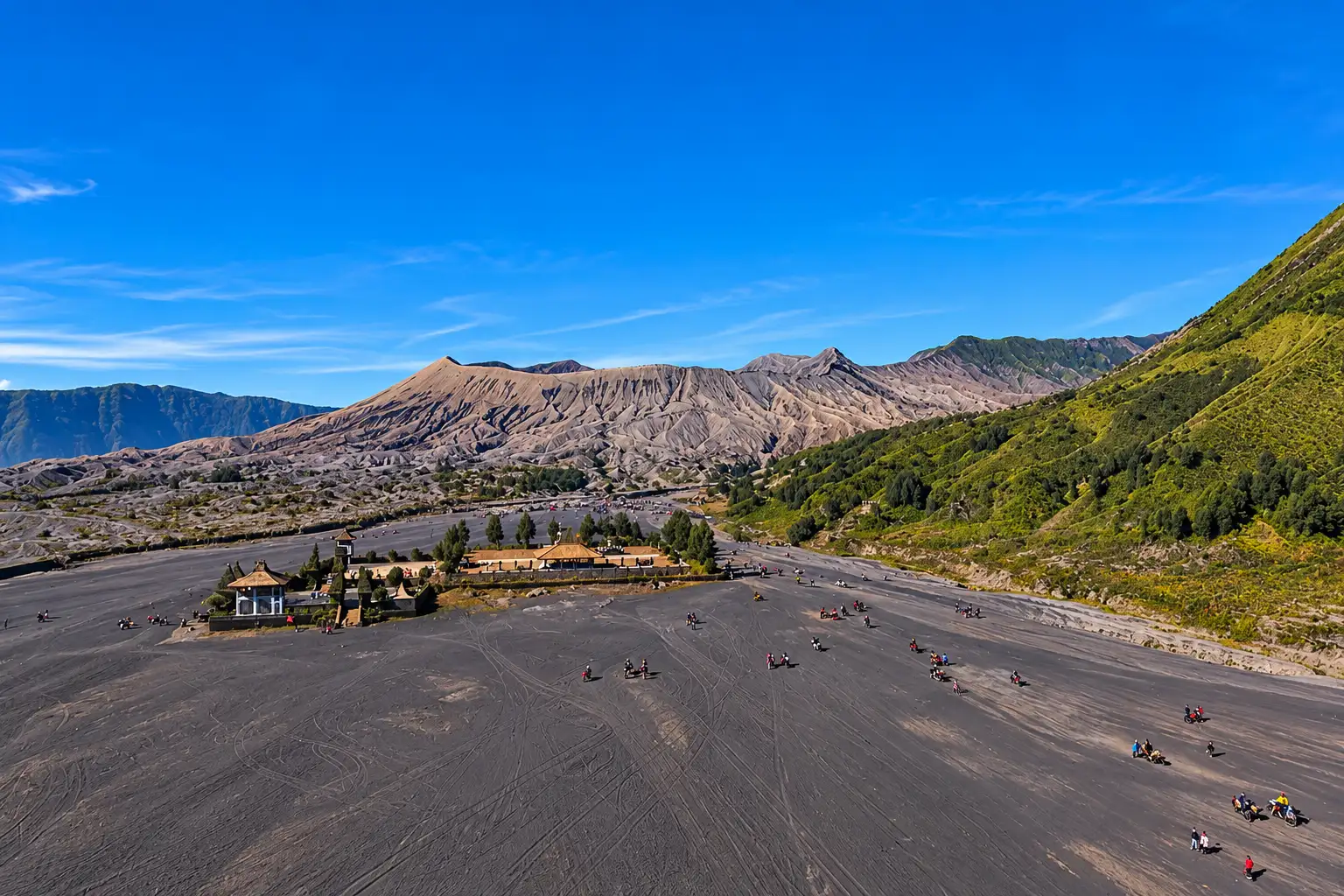
The Sea of Sand is also an important reminder that volcanic landscapes are constantly shaped by geological processes. The terrain may appear barren at first glance, but its unusual character is part of a much larger volcanic system that defines the geography of the Tengger region. For photographers, the open plain offers opportunities to capture the relationship between vehicles, mountains, and the vast surrounding landscape.
Walking to the Mount Bromo Crater
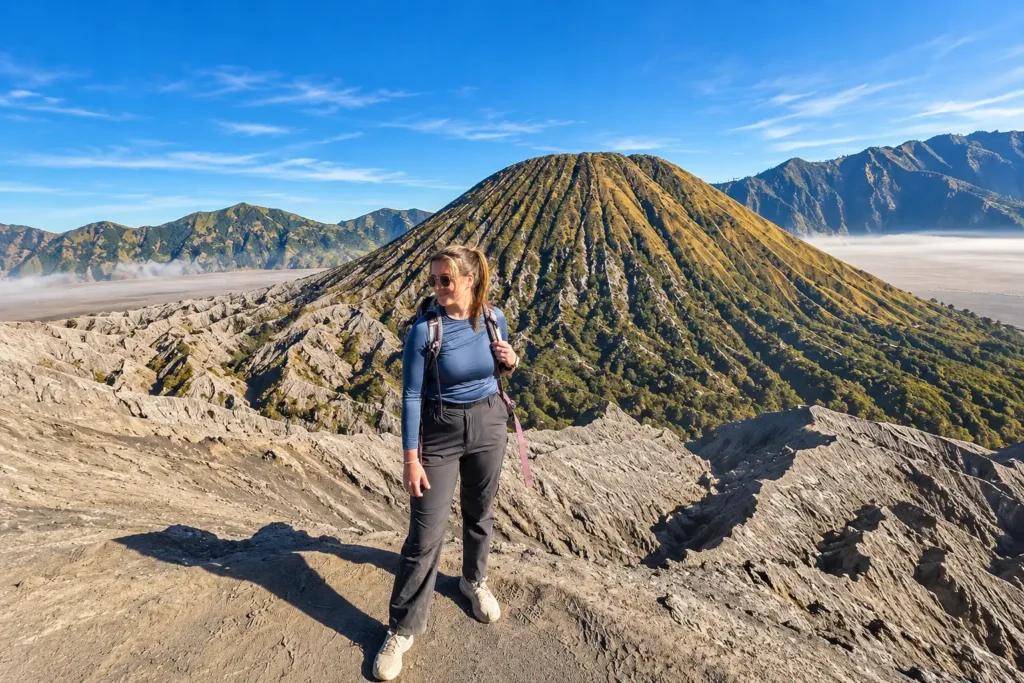
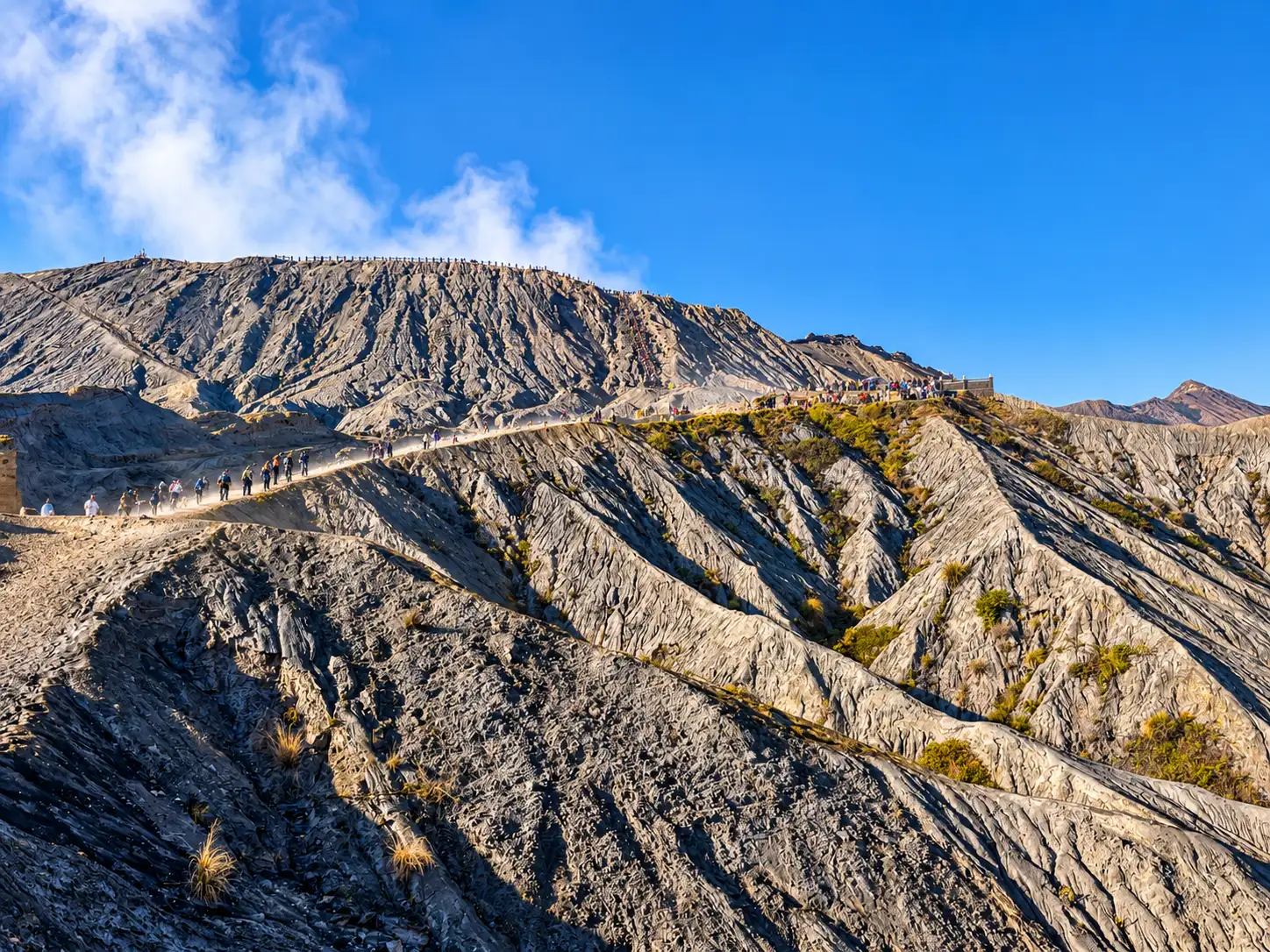
Approaching Mount Bromo itself is one of the most memorable parts of the visit. From the area near the volcanic plain, travelers continue toward the foot of the mountain, where a staircase leads up the slope to the crater rim. The walk introduces a more intimate perspective of the volcano, allowing visitors to experience the terrain rather than simply viewing it from a distant mountain platform.
The climb is relatively short compared with major trekking routes in Indonesia, although it can feel more demanding after an early departure. Sandy surfaces, stairs, crowds, and the physical effort of walking at elevation may require visitors to move at a comfortable pace. Good footwear and a free hand for balance are useful, particularly when the stairs are busy or dusty.
From the crater rim, visitors can observe the volcanic opening and the surrounding landscape from a closer perspective. Conditions may vary according to volcanic activity, and access can be restricted when authorities determine that additional safety measures are necessary. The crater should never be approached beyond designated areas or official safety boundaries.
It is important to remember that Mount Bromo is an active volcano. Visitors should follow the instructions of park officials, respect temporary closures, and avoid entering restricted zones even when the landscape appears accessible. A responsible visit prioritizes safety and respects the natural processes taking place beneath the surface.
The Cultural Landscape of the Tenggerese People
The mountains surrounding Mount Bromo are deeply connected with the cultural identity of the Tenggerese people. Their traditions, religious practices, and community life form an important part of the region’s character, giving the landscape a cultural dimension that extends far beyond its geological significance.
The Tenggerese are widely recognized for maintaining distinctive cultural and religious traditions, including the annual Yadnya Kasada ceremony. During this important ritual, members of the community gather in the Bromo region and make offerings into the crater as part of a longstanding spiritual practice. The ceremony reflects the relationship between local beliefs, ancestral traditions, and the volcanic environment.
One of the places associated with this cultural landscape is Pura Luhur Poten, a Hindu temple located within the Sea of Sand. The temple provides a striking visual contrast with the surrounding volcanic terrain and serves as an important spiritual location for the Tenggerese community. Its presence reminds visitors that the Sea of Sand is not simply an open recreational landscape but also a place of religious and cultural significance.
Travelers who explore Bromo with an understanding of its cultural context often gain a deeper appreciation of the destination. Respectful behavior, appropriate photography, and awareness of religious customs are important when visiting villages, temples, or ceremonial locations. The cultural identity of the Tengger region deserves the same attention as its famous mountain scenery.
Best Time to Visit Mount Bromo
Mount Bromo can be visited throughout the year, although seasonal weather has a significant influence on the experience. The dry season, generally extending from April to October, is often favored by travelers because rainfall is typically lower and conditions may be more suitable for sunrise viewing and outdoor exploration.
During the dry season, the landscape may appear more open and the volcanic terrain can become particularly dusty. Clear mornings are possible, but haze, clouds, and atmospheric conditions can still affect visibility. Temperatures before sunrise may be very cold, especially at elevated viewpoints, so warm clothing remains important regardless of the season.
The rainy season, generally associated with November through March, brings a different atmosphere to the mountains. Vegetation becomes greener, clouds move across the caldera, and the landscape can appear more dramatic after rainfall. However, wet weather may affect road conditions, visibility, and the comfort of outdoor activities.
Rather than choosing a date based exclusively on seasonal expectations, travelers should consider weather forecasts, official park information, and the flexibility of their itinerary. Mount Bromo is a mountain environment, and changing conditions are part of the experience.
How to Get to Mount Bromo
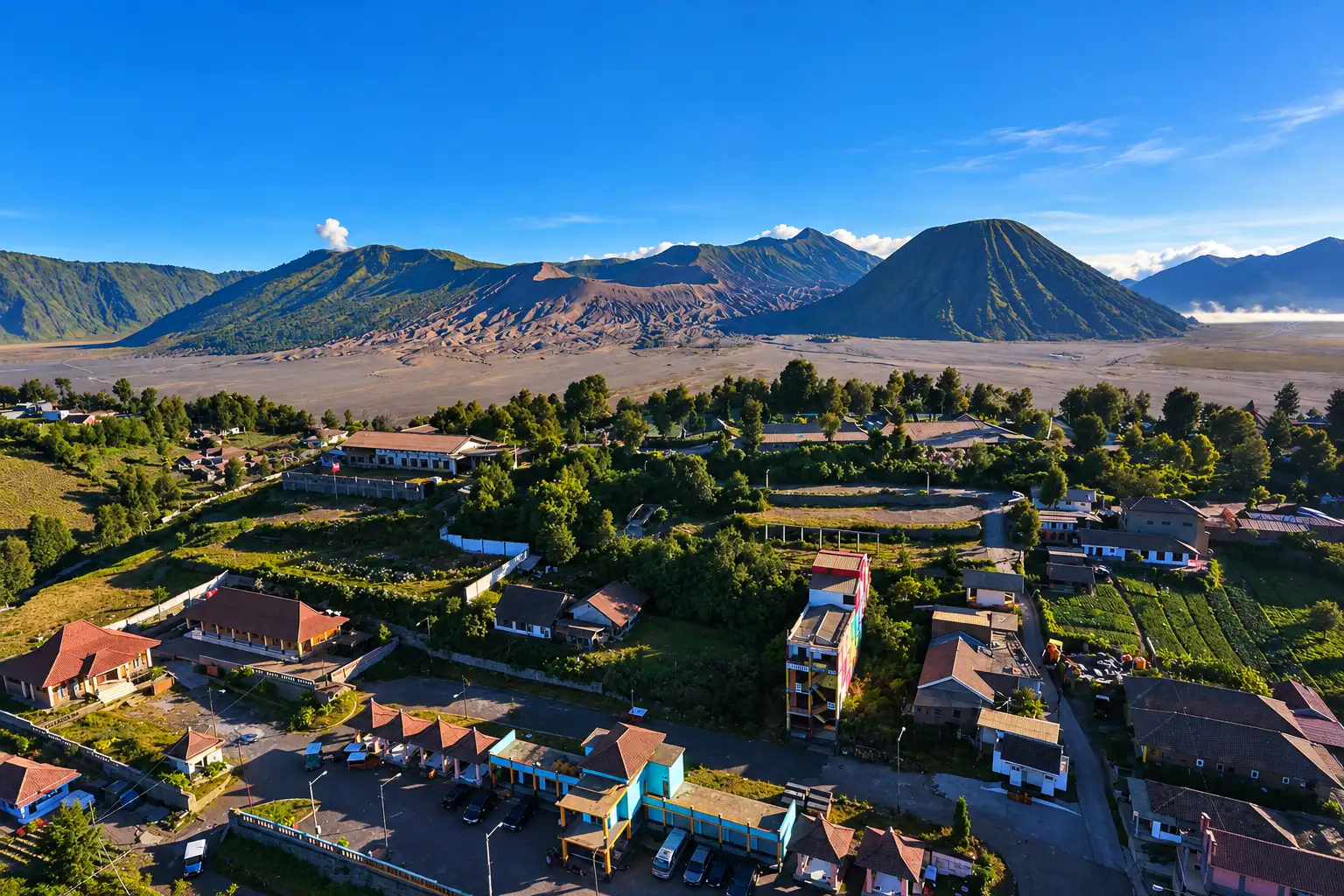
Mount Bromo is accessible from several destinations across East Java, including Surabaya, Malang, Probolinggo, and Pasuruan. The most practical route depends on your arrival airport, travel schedule, accommodation location, and whether you intend to continue toward Ijen Crater or other destinations.
Mount Bromo from Surabaya
Surabaya is one of the most convenient starting points for international and domestic travelers arriving in East Java by air. From the city, the journey toward the Bromo region takes several hours by road, depending on traffic, weather, and the chosen access route.
Travelers who want to experience sunrise without an excessively demanding schedule may choose to arrive in the Bromo area the previous afternoon or evening. This arrangement provides time to rest before the early morning departure and allows a more comfortable transition between transportation and sightseeing.
For visitors with limited time, a private transfer or organized excursion can simplify the journey. Explore our Mount Bromo Tour to discover travel arrangements that can be adapted to different starting points and itineraries.
Mount Bromo from Malang
Malang is another popular gateway to Mount Bromo, particularly for travelers exploring the highlands and natural attractions of East Java. Depending on the selected route, the journey may pass through mountain villages, agricultural landscapes, and scenic areas around the Tengger region.
The location of your accommodation is important when planning a sunrise excursion. Staying closer to the designated viewpoint or within the Bromo region can reduce early morning travel and provide more time to enjoy the landscape after sunrise. Travelers should also consider the route used for entering and leaving the national park when arranging transportation.
Mount Bromo from Bali
Mount Bromo can be combined with a journey from Bali, although the distance and ferry connection between the islands require careful planning. The overland journey generally involves crossing from Bali to East Java by ferry and continuing by road toward the Bromo region.
Because of the additional travel time, a multi-day itinerary is usually more practical than attempting to visit Mount Bromo as a short excursion from Bali. An overnight stay near the volcano allows travelers to enjoy sunrise without immediately undertaking another long journey.
For visitors who want to explore more of East Java, continuing toward Ijen Crater creates an excellent opportunity to experience two contrasting volcanic landscapes in one trip.
How Many Days Should You Spend at Mount Bromo?
One overnight stay in the Bromo region is a practical arrangement for most visitors. Arriving the previous afternoon or evening allows time to settle into accommodation, prepare for the early departure, and rest before the sunrise experience. The following morning can be dedicated to the viewpoint, Sea of Sand, and crater exploration before continuing to another destination.
A day trip from Surabaya or Malang is also possible, although it involves an early departure and a potentially tiring schedule. Travelers who prefer a slower pace, particularly those interested in photography or cultural exploration, may benefit from additional time in the region.
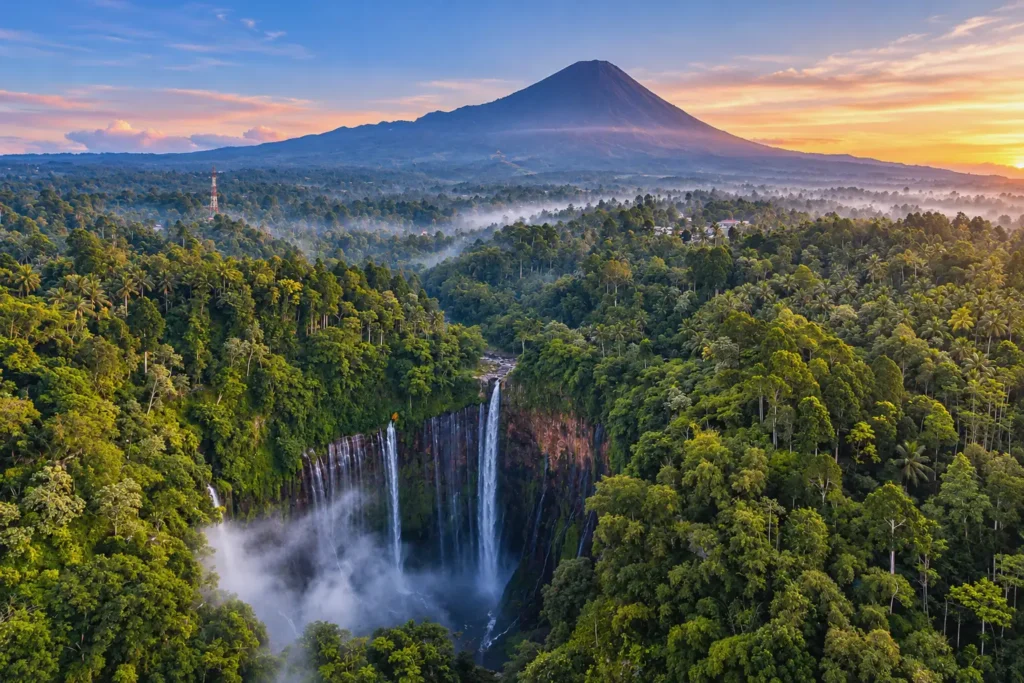
For a wider East Java itinerary, Mount Bromo can become the first major destination in a journey that continues toward Ijen Crater, Tumpak Sewu Waterfall, or other natural attractions. The additional time allows visitors to appreciate the diversity of landscapes across the province rather than concentrating exclusively on a single sunrise.
Suggested Mount Bromo Travel Itinerary
Day 1: Travel to the Bromo Region
Begin your journey from Surabaya, Malang, or another convenient starting point. Depending on your schedule, travel toward the Bromo region during the afternoon and arrive at your accommodation with enough time to rest. The evening can be spent enjoying the mountain atmosphere, preparing your clothing and equipment, and confirming the arrangements for the following morning.
Day 2: Sunrise, Sea of Sand, and Crater Exploration
Start before dawn and travel toward a selected sunrise viewpoint. After observing the volcanic panorama in the early morning light, continue into the Sea of Sand and explore the area surrounding Mount Bromo. Walk toward the crater rim when access is permitted, photograph the landscape, and take time to appreciate the geological features of the caldera. After the morning activities, return to your accommodation or continue toward your next destination.
Day 3: Continue Across East Java
Travelers with additional time can continue toward Ijen Crater or another destination in East Java. This extension provides an opportunity to experience different volcanic environments, mountain landscapes, and cultural settings while maintaining a more comfortable travel pace.
For visitors planning a broader adventure, our Bromo Ijen Tour combines the two volcanic destinations within one journey. Travelers interested in adding a waterfall experience can explore the Bromo Ijen Tumpak Sewu Tour, which extends the itinerary into another remarkable landscape of East Java.
Essential Mount Bromo Travel Tips
Preparing for Mount Bromo requires relatively little specialized equipment, but the mountain environment makes a few practical items particularly important. Temperatures before sunrise can be surprisingly cold, especially at exposed viewpoints where wind increases the sensation of low temperatures. A warm jacket, long trousers, and comfortable walking shoes will make the experience more enjoyable.
Travelers should bring drinking water, a small daypack, and a flashlight or headlamp if they expect to walk in low-light conditions. Sunglasses and sunscreen become useful later in the morning, when the open volcanic plain provides little shade. Dust may be present in the Sea of Sand, particularly during dry weather or when vehicles are moving across the terrain.
It is also important to understand that access to particular areas may change according to volcanic activity, weather, or park management decisions. Visitors should check official information before departure and follow instructions from park authorities throughout the journey.
What to Pack for Mount Bromo
- Warm jacket or insulated outer layer for sunrise.
- Comfortable walking shoes with good grip.
- Long trousers and layered clothing.
- Drinking water and a small daypack.
- Flashlight or headlamp for early morning movement.
- Sunglasses and sunscreen for daytime exploration.
- Camera, spare batteries, and photography equipment.
- Face covering or protection against dust when necessary.
- Personal medication and basic travel essentials.
Photography at Mount Bromo
Mount Bromo is one of the most rewarding landscape photography destinations in Indonesia because its scenery changes continuously with the light. The early morning hours are particularly attractive, when the sky gradually brightens and the volcanic peaks emerge from the surrounding darkness. The combination of foreground terrain, distant mountains, and atmospheric clouds creates opportunities for wide landscape compositions and more intimate photographs of the volcanic environment.
After sunrise, the Sea of Sand offers a completely different photographic setting. Dark volcanic terrain, jeep tracks, scattered vegetation, and the surrounding mountains create strong contrasts and distinctive textures. Walking closer to the crater can reveal dramatic details of the volcanic landscape, although photographers should always remain within designated safe areas.
Rather than focusing exclusively on the sunrise viewpoint, allow time to photograph Bromo from different perspectives. The most memorable images often come from exploring the landscape after the initial crowds have moved on and the changing morning light begins to reveal more detail. Patience, awareness of weather conditions, and respect for local regulations are essential parts of responsible landscape photography.
Responsible Travel at Mount Bromo
Mount Bromo is both a natural environment and a culturally significant landscape. Responsible travel helps protect the region while ensuring that local communities continue to benefit from tourism. Visitors should avoid littering, respect religious ceremonies, follow park regulations, and remain within designated routes and viewing areas.
Supporting local accommodation providers, guides, drivers, and community businesses can also contribute to a more meaningful travel experience. When photographing people or cultural activities, ask permission whenever appropriate and respect the privacy of local residents. The landscape may be famous internationally, but it remains part of the everyday lives and traditions of the communities who call the Tengger region home.
Travelers should also recognize that the mountain environment is subject to natural hazards. Volcanic activity, sudden changes in weather, slippery terrain, and dust can affect visitor safety. Following official instructions and adapting plans when conditions change are essential elements of responsible tourism.
Mount Bromo and Ijen Crater: Exploring East Java’s Volcanoes
For travelers with more time in Indonesia, Mount Bromo and Ijen Crater form an exceptional combination. Although both destinations are volcanic, their landscapes and experiences are remarkably different. Bromo is known for its immense caldera, Sea of Sand, and panoramic sunrise viewpoints, while Ijen offers a dramatic crater lake, rugged hiking terrain, and a distinctive volcanic environment shaped by sulfur deposits.
Combining the two destinations provides a broader understanding of East Java’s natural diversity. The journey also creates opportunities to explore mountain villages, local culture, and the changing landscapes that connect the region’s major attractions. For many international visitors, this combination represents one of the most memorable ways to experience Indonesia beyond its familiar island destinations.
Our Bromo Ijen Tour is designed for travelers who want to experience both volcanoes in one organized journey. For those who would like to extend their exploration beyond the mountains, the Bromo Ijen Tumpak Sewu Tour combines volcanic scenery with one of East Java’s most impressive waterfalls, creating a more comprehensive adventure across the region.
Frequently Asked Questions About Mount Bromo
Is Mount Bromo worth visiting?
Yes. Mount Bromo is one of Indonesia’s most distinctive natural destinations, offering spectacular sunrise viewpoints, an immense volcanic caldera, the Sea of Sand, and the opportunity to walk toward the crater rim. Its combination of scenery, accessibility, and cultural significance makes it a memorable destination for many types of travelers.
How difficult is the Mount Bromo hike?
Mount Bromo is generally accessible to travelers with moderate mobility and a reasonable level of physical fitness. The walk toward the crater involves stairs and sandy terrain, while the sunrise experience may require early morning movement in cold conditions. Travelers should take their time and follow official access instructions.
Can you visit Mount Bromo without a tour?
Independent travel is possible, particularly for visitors staying in the surrounding villages or arranging their own transportation. However, sunrise logistics, access arrangements, and transportation across the Sea of Sand can be easier with a local operator, especially for travelers unfamiliar with East Java.
What is the best time to visit Mount Bromo?
The dry season, generally April to October, is often preferred for sunrise viewing and outdoor exploration. However, weather conditions vary throughout the year, and clear sunrise views are never guaranteed. Travelers should check forecasts and local conditions before departure.
How cold is Mount Bromo at sunrise?
Temperatures can feel quite cold before sunrise, especially at exposed mountain viewpoints. Conditions vary with season, elevation, wind, and weather, so bringing a warm jacket and layered clothing is strongly recommended.
Can you see Mount Bromo and Mount Semeru together?
Yes. From several viewpoints around the Tengger Caldera, Mount Bromo can be seen alongside Mount Semeru, the highest mountain on Java. Visibility depends on weather, cloud cover, and atmospheric conditions, but the panorama is one of the defining features of the Bromo sunrise experience.
Is Mount Bromo an active volcano?
Yes. Mount Bromo is an active volcano within the Tengger volcanic complex. Its activity is monitored by Indonesian authorities, and access restrictions may be introduced when volcanic conditions require additional safety measures. Visitors should always follow current official guidance.
Can Mount Bromo be combined with Ijen Crater?
Yes. Mount Bromo and Ijen Crater are frequently combined in multi-day East Java itineraries. A journey of approximately three days and two nights is a popular arrangement, although the best duration depends on your starting point, transport connections, and desired travel pace.
How long should I stay at Mount Bromo?
One overnight stay in the Bromo region is a practical choice for most travelers. It allows time to rest before sunrise and explore the volcanic landscape the following morning. Additional nights are useful for travelers interested in photography, cultural experiences, or a slower itinerary.
Plan Your Mount Bromo Adventure
Mount Bromo is a destination that rewards travelers who take the time to experience its landscape beyond the first sunrise photograph. From the dramatic volcanic panorama of the Tengger Caldera to the vast Sea of Sand and the cultural traditions of the Tenggerese people, the region offers a memorable introduction to the natural and cultural richness of East Java.
Whether you are planning a short sunrise excursion or a longer journey across Java, choosing the right itinerary can make a significant difference to your experience. Transportation, accommodation, timing, and local knowledge all contribute to a smoother journey, particularly when visiting mountain viewpoints before dawn. A thoughtfully planned trip allows you to appreciate the destination at a comfortable pace while respecting the natural environment and local communities.
Explore our Mount Bromo Tour to discover available travel options, or continue your adventure with our Bromo Ijen Tour and Bromo Ijen Tumpak Sewu Tour. With thoughtful planning, Mount Bromo can become one of the most unforgettable experiences of your journey through Indonesia.